Multi‑Agent Systems – How Autonomous AI Agents Work in 2026
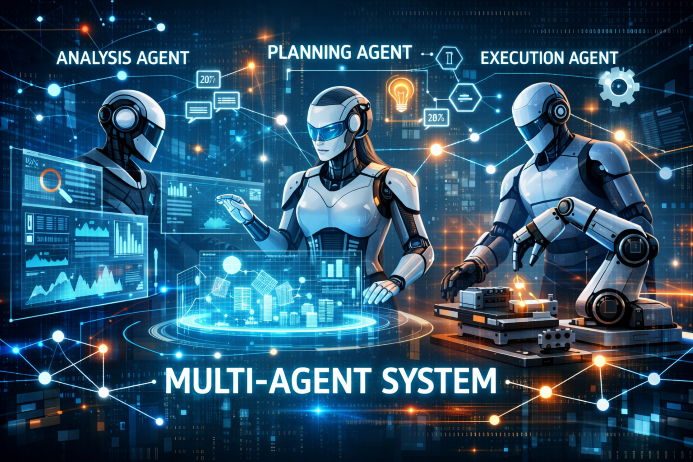
In 2026, artificial intelligence no longer operates as a single large model responding to commands. Instead, ecosystems of specialized AI agents emerge, collaborating, communicating, and making decisions together. These multi‑agent systems become the foundation of modern applications, capable of solving complex tasks without human intervention.
1. What a Multi‑Agent System Is
A multi‑agent system is composed of several AI agents, each with a clear role, working together to achieve a common objective. Every agent has its own abilities, rules, and decision‑making mechanisms.
Essential characteristics:
- Each agent has a specialization (analysis, planning, execution)
- Agents communicate through structured messages
- The system self‑organizes based on context
- Decisions are distributed, not centralized
2. How Agents Collaborate
AI agents do not work in isolation. They form a network where each contributes a piece of the solution. One agent may identify the problem, another may create a plan, and another may execute the task. Together, they function as an autonomous team.
Collaboration methods:
- Coordination: agents intelligently divide tasks
- Negotiation: agents decide who is best suited for each action
- Delegation: one agent can request help from another
- Feedback: agents adjust their behavior based on results
3. Advantages of Multi‑Agent Systems
The adoption of autonomous agents completely changes how modern applications operate. Instead of a single overloaded model, you have a team of agents working in parallel, fast and efficiently.
Major benefits:
- Natural scalability – add agents without rewriting the application
- Solving complex tasks through collaboration
- Reduced software development time
- Full automation of repetitive processes
4. Real Examples of Multi‑Agent Systems in 2026
More and more companies use multi‑agent systems to automate entire workflows. From software development to logistics, AI agents become part of the core infrastructure.
Representative applications:
- Teams of agents that write, test, and optimize code
- Autonomous assistants managing projects end‑to‑end
- Logistics systems coordinating deliveries in real time
- Analytics platforms generating reports without human input
5. Conclusion
Multi‑agent systems represent the next step in the evolution of artificial intelligence. In 2026, AI agents do more than respond to commands — they collaborate, plan, and make decisions together. This approach transforms how we build software and opens the path to fully autonomous applications.




Be the first to comment!