AI‑Native Development – Why 2026 Applications Are Built with Artificial Intelligence in Their DNA
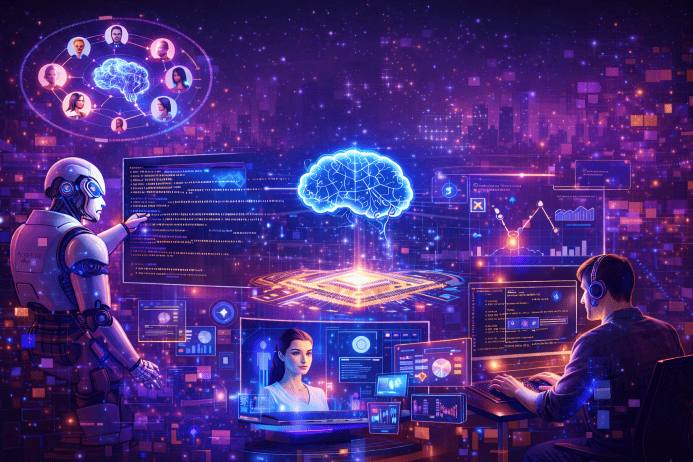
In 2026, software development undergoes the biggest transformation of the last two decades. Applications no longer use AI as an optional module — they are designed directly around it. The AI‑native concept reshapes how we write code, how applications function, and how they evolve over time.
1. What AI‑Native Really Means
An AI‑native application is not just an app that integrates a language model. It is software built so that artificial intelligence becomes part of its architecture, logic, and behavior. AI becomes the engine that optimizes, decides, and adapts the application in real time.
Essential characteristics:
- AI integrated into data flows and application logic
- Software components self‑optimize based on usage
- Decisions made through real‑time analysis
- Continuous learning from user behavior
2. How AI‑Native Changes Software Development
Developers no longer write only code — they design ecosystems where AI agents collaborate, verify, and improve the application. The development process becomes faster, safer, and far more efficient.
Direct impact on developers:
- Automatic generation of repetitive components
- Testing and debugging assisted by AI agents
- Documentation generated and updated automatically
- Continuous refactoring without human intervention
3. Real Benefits for Companies
AI‑native is not just a technological trend — it is a business strategy. Companies adopting this model reduce costs, accelerate releases, and gain a competitive advantage that is hard to match.
Advantages for organizations:
- Much faster time‑to‑market
- Reduced errors and operational costs
- Automatic scaling based on traffic
- Applications that adapt to user needs
4. Examples of AI‑Native Applications in 2026
More and more software products are built with AI at their core. From e‑commerce platforms to enterprise systems, AI‑native becomes the industry standard.
Representative applications:
- Dashboards that reorganize their interface automatically
- CRMs that predict customer behavior
- Learning platforms that personalize content in real time
- Mobile apps that adjust features based on user patterns
5. Conclusion
AI‑native is not just a new technology — it is a paradigm shift. Applications become alive, adaptive, and intelligent. In 2026, software is no longer just a set of functions, but a system that learns and evolves. Those who adopt this model early will define the industry standards in the years ahead.




Be the first to comment!